Right, so, last you'd heard, I was maybe going to have an operation on Tuesday the 10th. As you can surmise, that didn't happen. So, let me catch y'all up a bit.
On Thursday the 5th, I got to go home, and that meant I got to spend the weekend celebrating my birthday. On Sunday, Bethany, Stefanie, Victoria and I drove to Zella-Mehlis, a town deep in the Thüringer Wald, for the express purpose of visiting the aquarium there. We also met Alison there, and spent a few hours wandering among eerily blue-lit tanks and peering into the grotesque faces of their inhabitants. We watched the alligators being fed and made faces at the tiger sharks (well, I did) and talked to fish of all shapes and sizes. I can't help it; I love aquariums. (Aquaria?) Lucky for me, it was my birthday, so my ever-patient friends had to put of up with it.
Reemerging into the warm afternoon sunshine, we drove back to Jena to meet two more friends for dinner. First, though, we dug into the delightful chocolate buttercream cake that Stefanie had made for me, then we went off to find a cafe. We ended up at this silly bio-obsessed place, but thankfully I wasn't too hungry anyway because of the cake, so we just stayed and chatted and ate our all-organic sandwiches. Alison had to leave after dinner to get her train, and the rest of us decided to see a movie. Nothing was on at the cinema, so it was off to Anja and Claudia's flat.
Anja is the kind fellow Spanish student who had brought me to the English conversation group the first time. Her and her sister have a lovely flat in a quiet corner of Jena, and in honor of the day at the aquarium, we watched "Finding Nemo" in German.
After Bienenkunde the next day, I returned to Anja and Claudia's flat for a movie night--namely, Rapunzel. I cannot explain to you why I love this movie so much, especially in German, but it is so wonderfully adorably and preposterously cheesy I just can't help giggling madly when I watch it, even though I've seen it at least 10 times now. After that, we played SingStar until I realized that I was about to miss the last train, so we went flying through late-night Jena and I bolted on the train just in time.
Finally, the dreaded Tuesday morning rolled around, and Frau Woehlbier called the hospital to see what the verdict was. They said that they wanted to first do a biopsy to determine the exact nature of the growth, then a second operation to remove it altogether. They also wanted to bring in a renowned neurosurgeon to take part in the surgery, so it wouldn't be happening any time soon. That was good, because not only did I have two classes to teach that day, I was also coming down with a cold.
I snuffled and moaned through Wednesday but managed to recover by Thursday, which was very good because that Thursday was the Scottish Dance Night. Professor Liston (alias "Chunky", for no discernible reason; he looks like a slender, Scottish twin of Aaron Eckhard) of the Anglistik department is from Edinburgh, and 60 people crammed into one classroom to hear him, now be-kilted, play the bagpipes and learn some Scottish dances from him. Eventually, it got too loud and too packed, so we spilled out into the square in front of the university buildings to dance in more space. As much as I hate club and one-on-one dancing, I love group dances; there's a wonderful pattern and logic to them, and there's no pressure to be any more graceful or clever than the rhythm and sequence of the dance demands. When every member of the group pays attention and does their part right, there's a delightful sense of harmony that comes from every person working together to form and enjoy something beautiful. Also, Scotland is love.
On Friday, after a double guitar lesson (I'm learning a song involving lots of bar chords, which means the going is torturous and slow), I put on a skirt (no clean jeans left!) and went to see Thor in Jena with Bethany. Got to admit, for a Marvel movie about a Greek god, it was surprisingly interesting and well-done. Also, it was visually stunning, not only because of the 3D (which seems to be generally pointless and distracting) but simply the colors, effects, and images. Anyway, there are worse ways to spend a Friday evening.
Saturday was spent with a classmate, Maria, in the library working on a presentation for that wonderful Tolkien class I mentioned before. After three hours of Tolkienness, we broke off for coffee and cake (a German institution) at a flat belonging to a friend of Maria's. It was very kind of them to invite me, but the friend also had two young boys (one and three years old), which put me out of my element. I excused myself after a bit and went shopping, arriving home just in time for the start of the Eurovision competition.
Now, I'd heard quite a bit about Eurovision from "My English Friend" Stephen, who watches it religiously. For those Americans who have never heard of it, it's basically a Europe-wide singing Olympics. Each country sends a band, group, or singer to represent them; through the semi-finals, the number of entrants is whittled down to 25, and on finals night, each act performs before a screaming, flag-waving international crowd. Just like any other obnoxious reality performance show, the audience can then vote for their favorite; after the voting closes, the hosts video-call representatives from each country, who announce the points they have awarded. At the end of the night, the country with the most points wins a victory for their national pride, a hideous trophy, and the dubious and expensive honor of hosting next year's competition.
There are two things that struck me as a first-time Eurovision spectator. The first was the unbelievable quantities of tackiness, boyband-level cheesiness, and general glitzy and glamorous ridiculousness, all taken with completely straight-faced earnestness. The competition began with a cute kid from Finland who looked about 15 singing a ballad about world peace; Ireland was represented by Jedward, twins with hilarious red-sequined jackets and gravity-defying hair who can't sing to save their lives but bounced around the stage like hyperactive chipmunks on pogo sticks; the Moldovans were dressed in enormous cone-shaped hats and yodeled into their microphones as a girl with a trumpet circled them on a unicycle; and it was completely impossible to pay attention to Ukraine's rather good song, since behind her was a Ukraine's Got Talent (is that a thing?) winner drawing shapes in sand on a lightboard. Personally, I voted for Greece, who had a split act: an absolutely terrible rapper and a gorgeous young bloke singing in Greek amid jets of flame. I have to admit that I'm glad Eurovision isn't broadcast or even well-known in America; if it was, tourism into Europe would plummet as Americans realized with horror just how insane the Europeans really are.
The second thing that struck me was the oft-bemoaned (among people who care) fact that voting in the countries has little to nothing to do with the actual quality of the offerings and everything to do with the political and historical relationships between countries. Britain and Ireland voted for each other, as did Portugal and Spain, and Germany and Austria. But the main problem is that apparently, all the Eastern Bloc countries vote for each other, which is how we ended up with Azerbaijan as the winner. Really, now, how many people actually know where Azerbaijan is? I didn't--it's south of Georgia, bordering on the north of Iran, and if you just said, "Is that even technically Europe?" well, that's what I was wondering too, and since Israel also took part (what?!) I guess the definition of "Europe" is pretty loose at this point.
Anyway, if nothing else, it was highly amusing to watch--like a train wreck between an ICE carrying the sparkly costumes and sound equipment for Europe's Got Talent and a truck full of pyrotechnics. It was a cultural experience, at least.
Sunday was a trip to Gera with Victoria and Joe; we visited the Otto Dix house (some very odd paintings), played in a playground, then took the train back to Jena to meet Alison for a show at the planetarium. Going to the Jena Planetarium has been on my to-do list all year, and it didn't disappoint, although it wasn't anything I haven't seen in other planetaria before...except, of course, all the pinwheeling stars and beautiful galactic clouds were explained in German. Afterwards, we chatted over waffles at the Milchmix cafe about grammar, and I was thoroughly contented with my life.
This was unfortunately short-lived. After the first honey harvest on Monday and a class to teach on Tuesday, I headed to the English Stammtisch in Jena, which is the highlight of my week. But before I even got there, my left eye was starting to itch, and was seriously hurting by the time I finally gave up and headed home earlier than normal. This was so disappointing, since I had also been sick for last week's Stammi, and chatting with fellow language-lovers is one of the things I get the most joy out of.
By Wednesday morning, I could only open my left eye with stabbing pains and significant effort, but our Tolkien presentation was due so I packed up and shuffled off to Jena anyway, mostly blind. I made it through the presentation, but barely; it's extremely difficult to sound credible talking about heroic couplets and iambic pentameter with constantly watering eyes and a runny nose. After class, I found a doctor who prescribed me some antibacterial drops; I picked those up and headed to the train station, only to find the trains half an hour delayed. By the time I finally staggered back to my room in Stadtroda, I was exhausted and went straight to bed, having to miss entirely the goodbye barbecue party that the Stadtroda Stammtisch was throwing for Bethany.
Today, due to rest and medicine, my eye is better, but I can't help being a little irritated that I have managed to be sick with a different illness every week so far this month. The first week was the throat infection and tumor; the second was a cold; and the third is this cursed eye infection. I was perfectly healthy all winter, so my body seems to be taking revenge by making my life miserable now that the weather's nice.
Speaking of the tumor, here's the latest news. The surgery is tentatively planned for the 15th of June. My mother will be arriving here in Germany on the 9th of June so she can be there both before and after the surgery. The good news from today is that the insurance has confirmed that they will pay all costs, which I'm sure will be in the thousands of euro range. With the surgery still a month off, I have time to get over all the weird illnesses I'm suddenly susceptible to, and hopefully I'll recover quickly so as not to disturb my summer travel plans.
Now you know!
Showing posts with label beekeeping. Show all posts
Showing posts with label beekeeping. Show all posts
Thursday, May 19, 2011

Sweet Harvest
I entered the Bienenhaus on a cool Monday afternoon and breathed in deep of that exquisite smell: the sweet scents of wax and honey mixed with the comfortable mustiness that one finds in old houses and yellowed books, with just a whiff of the golden forsythia that bloom in exuberant explosions around the entrance. That smell, golden-brown, warm even in the dead of winter, and delightfully sweet, seems to promise sunshine no matter what the season or weather, but now it's especially apt: we're harvesting honey.
Inside the long-unused honey room, the Schleuder (centrifuge, for lack of a better word) was vibrating noisily. It looked like an enormous tin can, squatting on three slender legs, its spinning contents a blur under its plexiglass lid. But out of a faucet at the base ran a steady stream of golden honey through two sieves into a yellow bucket proudly marked ECHTER DEUTSCHER HONIG (Real German Honey).
The harvesting process begins outside, of course, at the Bienenstand. Several weeks ago, the hives were each given an extra Honigraum (a Zarge, or level, filled with empty honeycombs) separated from the rest of the hive by an Absperrgitter. This is a grating through which the smaller worker bees can crawl, but which is too narrow for the larger queen; this prevents the queen from laying eggs in the honey room. The beekeepers outside look through the hives, making sure the queen is in good health by either spotting Her Highness or by finding Stifte, tiny white newly-laid eggs. From the Honigraum they take out the Waben (honeycombs) that are full of honey and bring them to us in the Schleuderraum.
The bees let the honey air until the right amount of water has evaporated--about 18% is right--and then they cover the honey cells with a thin layer of wax. Our first job is to take off this covering with a special fork. We set aside the uncovered honeycombs to wait to be spun. As they sit in a rack, the honey drips down the open combs like syrupy raindrops; you can catch the drops on your finger and taste right away. Honey doesn't get any fresher than this.
Once there's room in the Schleuder, four honeycombs are loaded into spring-cushioned cages in the centrifuge's silver belly. A tiny white motor at the top spins the combs, extracting the precious honey and doing minimal damage to the combs themselves. Ideally all the honey is removed, and apart from a few tears and smushes, the combs are perfectly fine and can be replaced directly back into the hives for the bees to repair and fill again with honey.
One honeycomb contained a few wax-covered brood cells. As I leaned in to look, I noticed that one of the cells was missing its cover and instead, the triangular head and waving antennae of a hatching young worker bee were visible. I set that comb aside and waited, and in a few minutes, the young worker reached out of her confining cell with dainty black legs and pulled herself free: first head, then the thorax covered in downy silvery-tan hair and adorned with delicate wings, then the long abdomen striped in black and dark gold. We took her outside, and hopefully she found her way to her own or another hive. We spun that comb anyway with the rest of the brood still inside; we'll see if any of the rest survived.
We worked for about three and a half hours and produced more than six buckets of honey. I even took a jar of it home. This is how every Bienenkunde will be spent for a while: the bees will work hard to stock up with honey for the winter, we'll steal it away and give them the empty combs back to fill for us to steal again. There are some concerns that the hot, dry weather we've been having means the bees will run out of pollen, which is one of the ingredients of honey...but that remains to be seen.
Inside the long-unused honey room, the Schleuder (centrifuge, for lack of a better word) was vibrating noisily. It looked like an enormous tin can, squatting on three slender legs, its spinning contents a blur under its plexiglass lid. But out of a faucet at the base ran a steady stream of golden honey through two sieves into a yellow bucket proudly marked ECHTER DEUTSCHER HONIG (Real German Honey).
The harvesting process begins outside, of course, at the Bienenstand. Several weeks ago, the hives were each given an extra Honigraum (a Zarge, or level, filled with empty honeycombs) separated from the rest of the hive by an Absperrgitter. This is a grating through which the smaller worker bees can crawl, but which is too narrow for the larger queen; this prevents the queen from laying eggs in the honey room. The beekeepers outside look through the hives, making sure the queen is in good health by either spotting Her Highness or by finding Stifte, tiny white newly-laid eggs. From the Honigraum they take out the Waben (honeycombs) that are full of honey and bring them to us in the Schleuderraum.
The bees let the honey air until the right amount of water has evaporated--about 18% is right--and then they cover the honey cells with a thin layer of wax. Our first job is to take off this covering with a special fork. We set aside the uncovered honeycombs to wait to be spun. As they sit in a rack, the honey drips down the open combs like syrupy raindrops; you can catch the drops on your finger and taste right away. Honey doesn't get any fresher than this.
Once there's room in the Schleuder, four honeycombs are loaded into spring-cushioned cages in the centrifuge's silver belly. A tiny white motor at the top spins the combs, extracting the precious honey and doing minimal damage to the combs themselves. Ideally all the honey is removed, and apart from a few tears and smushes, the combs are perfectly fine and can be replaced directly back into the hives for the bees to repair and fill again with honey.
One honeycomb contained a few wax-covered brood cells. As I leaned in to look, I noticed that one of the cells was missing its cover and instead, the triangular head and waving antennae of a hatching young worker bee were visible. I set that comb aside and waited, and in a few minutes, the young worker reached out of her confining cell with dainty black legs and pulled herself free: first head, then the thorax covered in downy silvery-tan hair and adorned with delicate wings, then the long abdomen striped in black and dark gold. We took her outside, and hopefully she found her way to her own or another hive. We spun that comb anyway with the rest of the brood still inside; we'll see if any of the rest survived.
We worked for about three and a half hours and produced more than six buckets of honey. I even took a jar of it home. This is how every Bienenkunde will be spent for a while: the bees will work hard to stock up with honey for the winter, we'll steal it away and give them the empty combs back to fill for us to steal again. There are some concerns that the hot, dry weather we've been having means the bees will run out of pollen, which is one of the ingredients of honey...but that remains to be seen.
Monday, December 6, 2010
Playing with bees in the snow
Going to Bienenkunde today, I thought we were going to do something winter-ish, like watch a video about bees, or build more honeycomb frames, or something like we've been doing for the last few months. Uh...nope.
I came into the teaching room right at the beginning of a lecture on Oxalsäure. What exactly Oxalsäure is is not entirely clear to me (Leo says "oxalic acid" but that doesn't help at all), but that wasn't too important since I'm not sure what half the things we use in Bienenkunde are called in English anyway. It's kind of better that way. In any case, der Bienenmeister explained to us that we would be mixing distilled water, sugar, and Oxalsäure to make a thicker-than-water, highly poisonous concoction that we would then give to the bees. Apparently, the water dissolves both the sugar and acid crystals (this doesn't sound good), so that when the water evaporates, the bees eat and store the resulting crystals. The Oxalsäure is apparently not poisonous to the bees, but it is to the Varroa (a red-copper mite no bigger than an asterisk), which can kill off a hive during the winter if they're not treated. The varroa get into the cells with the larva and kill them before they can hatch. We had to treat for them now because the bees are not currently laying new young, so the mites won't be able to survive.
However, what this means is opening up the hive. It was warmer today than it has been recently, but the snow is still thick on the ground, and it was cold for even us. Imagine for a second...
It's comfortable in the warm, humming darkness inside the hive. The workers take turns beating their wings to generate heat, swarming in a clump around the all-important queen. The dark, furry mass migrates slowly around the hive, working their way gradually through the precious stores of food they've industriously stored during the summer. Inside the styrofoam boxes, they are safe and warm, content to stubbornly wait out the chilly winter outside.
Then, like the ending of the world, there is a loud crack, and their warm, snug home splits open. The cold whiteness of the outside world spills into the hive and the workers buzz frantically as their hard-earned heat disappears into the freezing air. The bees cling to each other, stumbling confusedly as the shock of cold numbs them; a few take to the air, rocketing around their attackers' heads, but their aggressiveness is suicide. Once they leave the hive, it will be shut behind them and they will absolutely die. It doesn't take long; some last longer than others, but all eventually plummet into the snow and struggle weakly against the remorseless cold until their meager warmth simply vanishes into the winter air.
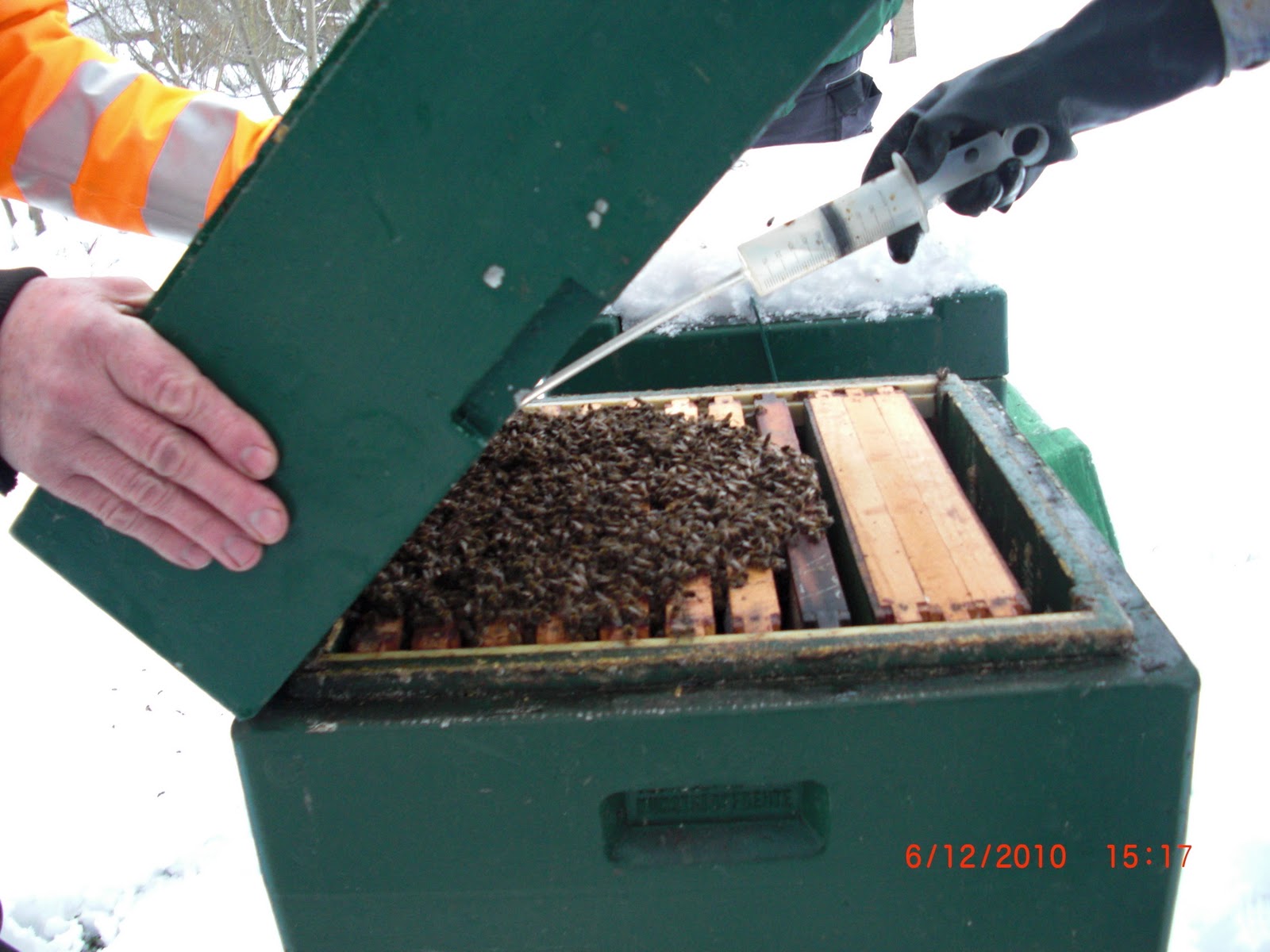
If you feel just a bit sad and horrified, that's how I felt today. We cracked open every hive to douse the confused bees with our concoction, which had to be dripped right on them to be effective. They didn't like it much, and I don't blame them at all.
As you may imagine, the first hive was the worst. The hives are built of several levels, in most cases three or four: a bottom level full of combs (Waben) that also has the hive's only entrance and exit to the outside; a second level (Zarge), completely open to the first, also full of combs; and sometimes also an extra level that earlier contained the sugary feed (Futter) that the beekeepers give them to replace their stolen honey; and last, the styrofoam roof (Decke). At the first hive, Manfried (one of the other beekeepers) didn't realize that the bees would be clinging to the bottom of the second level, and instead of just tipping it, he lifted the whole thing off and swung it over the snow. The bees were scattered, dropping dazed and twitching in the snow, and the shouting began. The Zarge was replaced, and we rescued as many bees as we could from the snow with a dustpan and a bird's wing, but the whiteness was still pocked by little black specks. Then the Bienenmeister doused them with the chemical and we moved on. I felt a little shaken. For heaven's sake, they're bees--but it's still heartbreaking to see them fighting to crawl out of the deathly cold, waving their legs and fluttering their wings, freezing to death, and know there's no way to help. I took to killing the ones that lay helpless in the snow. I don't know if they felt pain as the winter stole their tiny whiff of life away, but I tried to make it fast.
We went on to the next hive, then the next. Some were alive and abuzz with anger when we let the cold in; some sent out kamikaze pilots that flew at our faces, and one even stung Rolf; some were tiny groups, huddled determinedly around their queen and meekly accepting their chemical baptism; and two of the hives were ghost towns, all of the bees dead, frozen or flown or killed by varroa. Only once more did one of the beekeepers make mistake and spill the bees into the snow, but it wasn't so many as the first time. My job was mostly to follow and watch, or help clean the snow off the top of the hives to open them, but a few times I got to take the bird wing and gently sweep the staggering bees back into the hive before it closed again, crushing them or stranding them to die.
Like I said, this was more than a bit heartbreaking. It seemed cruel, too, to disrupt their warm seclusion, even though I know that the varroa, untreated, can destroy the hive. I picked one fallen bee out of the snow and it crawled on my finger, its tiny feet gripping my skin, its feelers wavering feebly. I tried to flick it back into its hive; I don't know if it made it or not. I hope so. Today's lesson made me look forward all the more to springtime--and swarming season...
I came into the teaching room right at the beginning of a lecture on Oxalsäure. What exactly Oxalsäure is is not entirely clear to me (Leo says "oxalic acid" but that doesn't help at all), but that wasn't too important since I'm not sure what half the things we use in Bienenkunde are called in English anyway. It's kind of better that way. In any case, der Bienenmeister explained to us that we would be mixing distilled water, sugar, and Oxalsäure to make a thicker-than-water, highly poisonous concoction that we would then give to the bees. Apparently, the water dissolves both the sugar and acid crystals (this doesn't sound good), so that when the water evaporates, the bees eat and store the resulting crystals. The Oxalsäure is apparently not poisonous to the bees, but it is to the Varroa (a red-copper mite no bigger than an asterisk), which can kill off a hive during the winter if they're not treated. The varroa get into the cells with the larva and kill them before they can hatch. We had to treat for them now because the bees are not currently laying new young, so the mites won't be able to survive.
However, what this means is opening up the hive. It was warmer today than it has been recently, but the snow is still thick on the ground, and it was cold for even us. Imagine for a second...
It's comfortable in the warm, humming darkness inside the hive. The workers take turns beating their wings to generate heat, swarming in a clump around the all-important queen. The dark, furry mass migrates slowly around the hive, working their way gradually through the precious stores of food they've industriously stored during the summer. Inside the styrofoam boxes, they are safe and warm, content to stubbornly wait out the chilly winter outside.
 |
| Sorry, meine liebe Bienchen. |
If you feel just a bit sad and horrified, that's how I felt today. We cracked open every hive to douse the confused bees with our concoction, which had to be dripped right on them to be effective. They didn't like it much, and I don't blame them at all.
As you may imagine, the first hive was the worst. The hives are built of several levels, in most cases three or four: a bottom level full of combs (Waben) that also has the hive's only entrance and exit to the outside; a second level (Zarge), completely open to the first, also full of combs; and sometimes also an extra level that earlier contained the sugary feed (Futter) that the beekeepers give them to replace their stolen honey; and last, the styrofoam roof (Decke). At the first hive, Manfried (one of the other beekeepers) didn't realize that the bees would be clinging to the bottom of the second level, and instead of just tipping it, he lifted the whole thing off and swung it over the snow. The bees were scattered, dropping dazed and twitching in the snow, and the shouting began. The Zarge was replaced, and we rescued as many bees as we could from the snow with a dustpan and a bird's wing, but the whiteness was still pocked by little black specks. Then the Bienenmeister doused them with the chemical and we moved on. I felt a little shaken. For heaven's sake, they're bees--but it's still heartbreaking to see them fighting to crawl out of the deathly cold, waving their legs and fluttering their wings, freezing to death, and know there's no way to help. I took to killing the ones that lay helpless in the snow. I don't know if they felt pain as the winter stole their tiny whiff of life away, but I tried to make it fast.
We went on to the next hive, then the next. Some were alive and abuzz with anger when we let the cold in; some sent out kamikaze pilots that flew at our faces, and one even stung Rolf; some were tiny groups, huddled determinedly around their queen and meekly accepting their chemical baptism; and two of the hives were ghost towns, all of the bees dead, frozen or flown or killed by varroa. Only once more did one of the beekeepers make mistake and spill the bees into the snow, but it wasn't so many as the first time. My job was mostly to follow and watch, or help clean the snow off the top of the hives to open them, but a few times I got to take the bird wing and gently sweep the staggering bees back into the hive before it closed again, crushing them or stranding them to die.
Like I said, this was more than a bit heartbreaking. It seemed cruel, too, to disrupt their warm seclusion, even though I know that the varroa, untreated, can destroy the hive. I picked one fallen bee out of the snow and it crawled on my finger, its tiny feet gripping my skin, its feelers wavering feebly. I tried to flick it back into its hive; I don't know if it made it or not. I hope so. Today's lesson made me look forward all the more to springtime--and swarming season...
Monday, November 15, 2010
Christmas list and Sunday dinner
Random things today. Lisbon will be up later, I promise.
I don't have anyone to tell this to, so I shall post it on the Internet in general, which cares even less than anyone else, being an impersonal global network of electronically encoded information, but, y'know, whatever, eh?
Christmas List! <3
-DVDs: Sherlock, Top Gear, How to Train Your Dragon, Inception
-Gift cards to Amazon (for Kindle books and music!)
-Poster of the IPA
-A BahnCard
-A visit from my mom :)
-A new pair of boots
Um...that's all.
I'm very worried about my grandmother, who is not recovering well from a recent shoulder surgery. It's frustrating to be so very far away and unable to do anything to help and comfort my family. Luckily, should the need arise, I can get a round-trip flight for about $1000, the downside being that it's about 18 hours each way, plus jetlag. It would be worth it, though, if I were needed. I just feel like of selfish and useless.
Anyway. Yesterday was an absolutely delightful day; I spent a few hours in the morning tutoring my mentor teacher's daughter in Japanese, which is an adventure for both of us. I have trouble remembering which language I'm supposed to be speaking in, and my Japanese is pathetically rusty. Still, my pupil is eager to learn, and we have a great time talking together about anime and such. After that, Bethany and I were picked up by Claudia, one of the Fachschule students, to visit her home for Sunday dinner. We went to see her horses, visited the town's surprisingly spacious zoo, and had an absolutely fabulous home-cooked German meal.
Claudia's stepfather is from Yorkshire, so he and Bethany got to commiserate extensively on how wrong everything (food, TV, holidays, etc) is in Germany. I had to focus carefully on what he was saying to understand him sometimes! Claudia's mother is a sweet, generous woman, and she was kind enough to speak simply and clearly to me so I could understand her. And the food was so delicious! I wish I could cook like that! Perhaps the best part for me, though, was that I felt genuinely welcome in a German home--only the second time since I've arrived.
Also, Claudia and her family invited me to stay with them over Christmas, which brings my total number of invites up to four. Ah, me...what shall I do? I'd like to clone myself, send off the clones to each house, and then unite back into one person so I could have the experience of each. (There is precedent for this.) Given that that is, unfortunately, impossible at present, I'll have to make a decision. Yuck, decisions. I think I'll procrastinate on this one.
I only had to teach one class today, but I have Bienenkunde at 2pm. My lesson consisted of reading a text about my experience in Germany/learning German, and then asking them what they think about English. There were a lot of "boring" and "hard" sentiments expressed, and many mentioned that they want to learn more vocabulary. I find this somewhat amusing, since the statement "Today we're going to be learning some new vocabulary!" is usually met with groans of agony. Ah well.
I'm off to lunch, then to deliver our Operation Christmas Child box, then to Bienenkunde in the wind and rain. Wish me luck!
ADDED: Forgot to mention that I finally got the e-mail notifying me that tickets to the filming for Top Gear are now available. I sent my request in right away; we'll see what happens! If I don't get the tickets--which is much more likely--I'll still get to spend the week with "my English friend" Stephen. (The quotes aren't there for sarcasm. The phrase implies that Stephen is my only English friend, which he isn't anymore, but he was when I started calling him that. The quotation marks show that the phrase is now an honorific title instead of a expression of reality.) We were thinking of traveling somewhere in Germany together, depending on how it all works out. If I do get tickets, I requested two, so Stephen and I can both go. Either way, I'm very much looking forward to February! :D
I don't have anyone to tell this to, so I shall post it on the Internet in general, which cares even less than anyone else, being an impersonal global network of electronically encoded information, but, y'know, whatever, eh?
Christmas List! <3
-DVDs: Sherlock, Top Gear, How to Train Your Dragon, Inception
-Gift cards to Amazon (for Kindle books and music!)
-Poster of the IPA
-A BahnCard
-A visit from my mom :)
-A new pair of boots
Um...that's all.
I'm very worried about my grandmother, who is not recovering well from a recent shoulder surgery. It's frustrating to be so very far away and unable to do anything to help and comfort my family. Luckily, should the need arise, I can get a round-trip flight for about $1000, the downside being that it's about 18 hours each way, plus jetlag. It would be worth it, though, if I were needed. I just feel like of selfish and useless.
Anyway. Yesterday was an absolutely delightful day; I spent a few hours in the morning tutoring my mentor teacher's daughter in Japanese, which is an adventure for both of us. I have trouble remembering which language I'm supposed to be speaking in, and my Japanese is pathetically rusty. Still, my pupil is eager to learn, and we have a great time talking together about anime and such. After that, Bethany and I were picked up by Claudia, one of the Fachschule students, to visit her home for Sunday dinner. We went to see her horses, visited the town's surprisingly spacious zoo, and had an absolutely fabulous home-cooked German meal.
Claudia's stepfather is from Yorkshire, so he and Bethany got to commiserate extensively on how wrong everything (food, TV, holidays, etc) is in Germany. I had to focus carefully on what he was saying to understand him sometimes! Claudia's mother is a sweet, generous woman, and she was kind enough to speak simply and clearly to me so I could understand her. And the food was so delicious! I wish I could cook like that! Perhaps the best part for me, though, was that I felt genuinely welcome in a German home--only the second time since I've arrived.
Also, Claudia and her family invited me to stay with them over Christmas, which brings my total number of invites up to four. Ah, me...what shall I do? I'd like to clone myself, send off the clones to each house, and then unite back into one person so I could have the experience of each. (There is precedent for this.) Given that that is, unfortunately, impossible at present, I'll have to make a decision. Yuck, decisions. I think I'll procrastinate on this one.
I only had to teach one class today, but I have Bienenkunde at 2pm. My lesson consisted of reading a text about my experience in Germany/learning German, and then asking them what they think about English. There were a lot of "boring" and "hard" sentiments expressed, and many mentioned that they want to learn more vocabulary. I find this somewhat amusing, since the statement "Today we're going to be learning some new vocabulary!" is usually met with groans of agony. Ah well.
I'm off to lunch, then to deliver our Operation Christmas Child box, then to Bienenkunde in the wind and rain. Wish me luck!
ADDED: Forgot to mention that I finally got the e-mail notifying me that tickets to the filming for Top Gear are now available. I sent my request in right away; we'll see what happens! If I don't get the tickets--which is much more likely--I'll still get to spend the week with "my English friend" Stephen. (The quotes aren't there for sarcasm. The phrase implies that Stephen is my only English friend, which he isn't anymore, but he was when I started calling him that. The quotation marks show that the phrase is now an honorific title instead of a expression of reality.) We were thinking of traveling somewhere in Germany together, depending on how it all works out. If I do get tickets, I requested two, so Stephen and I can both go. Either way, I'm very much looking forward to February! :D
Thursday, September 30, 2010
Kürzlich
September 23rd
While working at my computer by my open window, I heard over my music a voice shouting, but it took a good few seconds for it to register consciously. Someone out of the view of my window was announcing something important about the Realschule in a megaphone, something that I couldn't quite catch. Bethany and I both poked our heads out in curiosity, but as nothing seemed to be on fire and there were no screams of panic, we shrugged and went back to work. This only lasted until strains of music began drifting in some minutes later. Leaning out the window, we found that a marching band was coming down the street, playing brightly, accompanied by brigades of fireman in their black-and-reflective-yellow gear and followed by a long parade of people of all ages. Most of them, from adults down to young kids, were carrying lanterns or, more often, lit firebrands. I'd seen enough; I grabbed a coat and my keys and dashed from the room to check it out.
Bethany and I stepped out of our dorm and joined the firelight flow of people, which must have comprised the entire population of Stadtroda by the size of it, in a circuit through the apartment complexes around the Wohnheim. We tried to ask what the parade was about, but all I could gather was that it was for the "Feuerwerk" (firework), which made some degree of sense, given the torches, but still wasn't entirely clear. We strode along anyway; I was burning with curiosity, and was just starting to contemplate the most subtle way that I could steal a torch from an unsuspecting child when a bright light flashed somewhere nearby. I looked around for the camera, but that mystery was solved a few seconds later by an ominous rumble from the darkening sky. And sure enough, soon fat raindrops were plonking us on the head, and within minutes it was an outright downpour, complete with atmospheric lightening and thunder. I couldn't help feeling a rush of deja vu and wondering: for Heaven's sake, what does God have against lantern parades?
We trotted on after the rest of the parade through the rain, and shortly we turned into a small field near the Wohnheim, where sausage and beer stands had been set up (anyone surprised?) and the arriving paraders tossed their torches into an enormous pile of brush and firewood piled at least 12 feet high. Party, anyone?
Bethany and I dashed back to the Wohnheim to get proper rainjackets and cameras, although the heavy rain had quit before we stepped through the door and settled instead on a drizzle. It seems God knew what He was about, though: by the time we returned to the field, the pile of brush and torches was an enormous raging bonfire, like a miniature volcano with a baby dragon at its heart, blowing clouds of sparks defiantly up at the unfriendly skies--so all told, it was probably a good idea to douse everything thoroughly first.
Having not yet eaten dinner, I got in line for a bratwurst while Bethany (a vegetarian) went to find some popcorn. I finally worked up the courage to ask some nice ladies in the line behind me and found out that the party was for the Feuerwehr (fire department), which seems both beautifully appropriate and wonderfully ironic, and explains either way the surplus of tough-looking guys stumping around in neon-lined boots and jackets and casting baleful, watchful glares over the bonfire. I got my bratwurst, Bethany got her popcorn, then we shared a perfectly ginormous cotton candy that was melting in the rain as we ate it. Finally, we both bought some Gluehwein and stood back to watch the fire burn spectacularly.
The entire thing was completely surreal in its suddenness and sheer randomness. It was like everyone in Stadtroda, having not a whole lot better to do on a cloudy afternoon in late September, looked at each other and said, "You know what would make this so much better? An humongous raging bonfire. We can have little kids carry the lit torches! To, y'know, celebrate the Feuerwehr and drink some beer or whatever." And the concensus was: "That sounds brilliant. I'll go get the grill and some kerosene!"
I love Germany.
September 25th
I slept in late today (11 at least) and finally managed to drag myself through the cold drizzle to the train station just in time to miss the train to Jena entirely. Luckily, I always come prepared, so I just pulled out my copy of Emma and waited for the train going the other way instead. This was how I ended up in Gera, a big-ish town about 20 minutes from Stadtroda, wandering in circles trying to figure out which street the signs to "Zentrum/Tourist Infos" were pointing up. I never did find either the city center or the TI, as far as I know. I just set off in the right general direction and wandered into any open shop doorway that looked interesting.
There were a lot less of these than you would think to find on a Saturday afternoon, and not for lack of interestingness but rather for lack of openness. While Saturday is I'm-not-working-today-so-let's-go-shopping-or-do-something-interesting-for-Pete's-sake day where I come from, apparently it's I'm-going-home-at-2-today-because-I-feel-like-it-so-if-you-wanted-to-buy-something-you-should've-come-during-the-week day in Germany. Many of the shops were dark and locked, although in their defense, the wide streets were almost deserted, and the whole center had a ghost-town vibe about it, especially on the rare occasions when I did pass another pedestrian, almost inevitably with their eyes fixed on the pavement and in total silence. It was somewhat creepy.
Nevertheless, I've been on a mission for the last few weeks: to find and buy a Sheepworld pencilcase. You see (those are the opening words of a story you most likely won't care two socks about, so feel free to skip the next couple sentences), I bought one last time I was in Germany and loved it dearly right up until it unceremoniously disappeared sometime between winter and spring quarters this year. Although I found one in Cologne, I foolishly assumed that I'd be able to find them everywhere, and have been searching for them in vain ever since. To my joy, I found just the one I'd been looking for, and bought it with a minimal amount of the prerequisite dithering that accompanies every purchase over 4 euro.
To suppliment the somewhat unreal feeling of the deserted streets of the rain-drenched city, I emerged from a shopping center to find that Milka (the chocolate company) had a little...booth/exhibit thing set up, where they were letting passersby play Milka-related computer games, sample their chocolate, and pet a stuffed purple cow. The best bit was the giant inflatable cow atop the main trailer, which looked a bit odd to me, mostly because it wasn't upside down.
September 27th
Mm, my fingers smell like beeswax. Yum.
Today was Bienenkunde day, but ever since the Feuerwehr Day downpour, the weather's gone from sunny, warm, and gorgeous to cold, wet, and miserable. In fact, it feels almost entirely exactly like Washington--fancy that. Anyway, apparently the bees really don't like it if, after all the trouble they go to keep their hive warm and dry, you go about pulling it apart and letting the water in, so we weren't allowed to peek in the hives today.
It seems I've simply been adopted as the new apprentice beekeeper. That's fine with me, although I regret that I can't understand nearly as much as I would like, since it's all explained to me in German. At this rate, I'll have elevated nodding and smiling strategically to an art form. This also means I don't actually know the English names of half the things I learned about today, but I'll do my best.
My main task today was sorting the Waben, which are easily removable and replaceable wooden frames in which the bees build the wax cells for storing food or raising young. Because the honey is extracted from the Waben without destroying them, they can be reused when the bees become more active again next spring. I learned to identify the difference between Futterwaben (Waben with, uh, Futter in them, which is, I think, like nectar) and Pollenwaben (Waben with pollen and honey in them...the distinction is harder than you'd think). I started to learn to tell apart cells built by workers (Arbeiterinnen) and drones (Drohnen)--the drones' cells are bigger, and ofter have specially-shaped cells for a new queen--and I had to keep a lookout for the larvae of the Wachsmutte (wax moth?), which lays its eggs in the Waben, and when the eggs hatch, the larvae eat through the wax and destroy them. The Wachsmutte has to be killed wherever it's found, although apparently, the earwigs that I found in several combs are good, because they eat the Wachsmutte larvae. Eurgh--spiders and bees and such I can handle, but I really don't like earwigs. They're worse in German: Ohrkriecher (ear-crawler).
Jürgen, the head bee man, seemed to be apologetic that today's tasks weren't nearly as exciting as last week's, but the way I figure it, whenever you get a new pet, you get to name it and play with it and coo and take pictures, but you also have to learn how to take care of it properly. I guess he just doesn't want me to give up on the oh-so-glamorous world of beekeeping because of the boredom of sorting through boxes of wax looking for larvae and brushing away earwigs. I thought it was interesting, I got to practice my German, and the smell of those Waben is absolutely lovely.
If I ever do build that dream house that I'm designing in my head, which already has a red Dublin-style Gregorian front door, a Japanese tatami room with sliding rice-paper doors, and German windows, I may have to have a little styrofoam tower of bees in the backyard, too.
September 28th
Oh, have I mentioned that I joined the church choir?
This is the best opportunity so far to actually speak some German and meet other people in the community, although the first session, two weeks ago, was unportentious: I'm totally out of practice with minor skills like, say, reading music and singing in tune/harmony, and the first practice was a whirlwind of German music terms and songs I don't know. Bethany and I kept exchanging overwhelmed glances as we tried to catch the rhythm, sing in tune, read the notes, and pronounce the German lyrics simultaneously. I didn't go last week partly because I was feeling sick, and partly because I didn't want to go through the frustration.
Bethany convinced me to go again tonight, though. I felt like I could hear my harmony part more clearly (I am really miserable at singing in harmony) and the other girls in the choir were very kind and helped me keep track of where we were. After an hour, we took a break for a small potluck dinner, and as we were eating, more people arrived, almost all significantly older. Apparently there's a second choir (?), and we were all going to practice together. This was just as confusing, but after a good hour and a half of fighting with music I'd never seen before, we adjourned and were warmly greeted by all the sweet ladies, who had also brought cake for someone's birthday that they eagerly encouraged us to try. One lady in particular struck up a conversation with me, and she invited Bethany and me over to house for coffee repeatedly, saying that she was all alone now that all three of her kids are grown.
Being treated with friendliness, interest, and warmth is certainly a welcome change. I've decided that I officially dislike German dorms on principle, but really, it isn't the building's fault (entirely; it is in part). The students are either too shy, too lazy, or too disinterested to actually come seek Bethany or me out, or even really talk to us when we meet by accident. I'd almost started to think that we were doing something wrong, but from the choir's friendly welcome, I must conclude that the students are just self-conscious and busy young adults. That's rather sensible, isn't it?
Also in music news, I was accepted to the music school for guitar lessons (YAAAAAAY!). The only downside at this point is that the lessons are one-on-one, so I won't be able to meet other Germans interested in learning the guitar. My own beloved instrument is still in WA, but Katrin's son has kindly agreed to let me use his, so soon I'll be recklessly annoying anyone who dares to come within hearing distance with my painstaking twanging noises. I start on Friday!
Tomorrow I'll take the train to Jena to meet my university Tutorin, who's been corresponding with me about starting uni and how to matriculate. She's been kind enough to agree to come and meet me and go to the office with me. I'me excited to meet her, although I was a bit embarrassed to find out today that although she addresses me as "du", I should be addressing her as "Sie", and I haven't been. Oops. Curse you, L2 politeness distinctions, for being so confusing!
While I'm here, I wanted to mention the students again. As anyone who's ever been in more than one class session in their life knows, every class group has a different personality, made up of not only the students' individual personalities but also their attitudes, past experiences, willingness to talk, willingness to act, and their interactions with each other and the teacher. Some classes simply click, others simply don't, and the teacher can only improve a curdled classroom to a certain degree.
I have one class that I particularly love that is especially effervescent. There are two students in the class who don't care much, but four of the students are reasonably competent in English and willing to talk, one is shy but willing to participate, and two are low-level beginners. The disparity in ability makes this class tough, but they're all such fun that it doesn't matter as much. I definitely look forward to working with them, and I hope to get to know some of them outside class as well.
Unfortunately, they're pretty much the exception. The attitudinal temperature of the other classes ranges from lukewarm to downright subzero. I haven't encountered any outright hostility yet, but there seems to be an American/German culture gap over the acceptability of talking while the teacher's talking that had me really pissed off today. I'm determined, though, to try to think of more engaging activities so the students won't be as likely to look for amusement elsewhere.
September 29th
The reason this is taking me so long to post is that my Internet is still down, and the tech guy for the Fachschule seems to have no interest in fixing it. There's a monthly 1 GB limit which I unknowingly overstepped, but a few days after he fixed it, it stopped working again, and although I've sent him an e-mail, it's still kaput. Luckily, the end of the month is only two days away now, so I should be able to survive until then. The upside is that I get to bed much earlier, since I don't have the temptation of wandering down the Internet's many twisting alleyways until the wee hours of the night. Also, I can't check my Facebook every half hour.
On the topic of frustrating delays, ARGH German universities are so silly! I understand the need for health insurance certificates and other such guarantees, but whereas American universities (well, mine, at least) seem to be able to condense all the registration and information exchange processes, the German ones seems to delight in making them as complicated as possbile.
I met my tutor, Kati, at the train station, and had a delightful time talking with her the whole day (in German, too! Go me!). She took me to the immatriculation office, where the lady explained to me in clear, simple German that I still had to send in more paperwork and pay the semester fee before they'd give me the student card I could already see lying tauntingly in my folder. Having not accomplished much except having recieved a whole lot of new info-papers, we set off again. To pick up my free planner, we had to take a voucher to a small office tucked away in a different building; to sign up for my e-mail address and log on to the university system, we had to visit a completely anonymous office in yet a different office building; the library was on the other side of the town center, where we discovered that not only would I have to sign up for yet another account, I couldn't do so until the official start of the semester on the first of October. Does this seem needlessly complicated and vaguely sadistic to you, too?
Take, for example, the library. Like I said, I can't register for an account at the library until Friday, so I can't even go in yet. (What?) Also, the library doesn't let you bring any food or drink or anything, and I guess they're afraid you'll try to (somehow) smuggle books out or something, so they provide lockers where you have to leave all the stuff that you aren't going to actually use in the library--your backpack, coat, wallet, etc. This seems to me like a completely pointless precaution; I know that I've ordered pizza for a group project in the library at least once, and somehow nothing caught on fire or was wantonly destroyed. You may think that this was to protect the clearly new library, but the university library in Marburg was as new and as aesthetically pleasing as a warthog carcass, and they had a similar system. They have those scanner things that you have to walk through, too, so stealing books'd be tough. So, seriously, WTF?
I can only conclude that American universities feel like they have to treat their students well (ish) and make things convenient for them (ish) because we have to pay so blasted much. The uni fee in Jena is like 500-600 Euro, Kati told me--whether that's per year or per semester, it's still facepalmingly small compared to American tuition. I didn't even mention that I have to sign up for this thing called Onleila, which is the interface that allows me to register for classes, but my tutor can't tell me how to use it because it's different from the one she uses. The motivation behind these inane complications must be spite, fueled by having to give away an education practically for free. It's the only logical explanation.
Alright, enough with the griping. I may or may not have mentioned before (and I can't check, because my Internet doesn't work) that Bethany and I attend an English Stammtisch (discussion group) on Wednesday nights. The group gets along well; they're all adults wanting to practice and improve their English. Tonight we talked about the word "Fackel" (say it out loud and you might see why it's so funny), whether or not to pronounce the "h" in "herb", and the American words "nuke" and "floored" and their British counterparts. Tonight the group even considerately offered to make one night a month a German night so that Bethany and I can be sure to get some practice in.
Also, tomorrow I'll go to my mentor teacher's house to start teaching her daughter Japanese and pick up my guitar. Hooray!
While working at my computer by my open window, I heard over my music a voice shouting, but it took a good few seconds for it to register consciously. Someone out of the view of my window was announcing something important about the Realschule in a megaphone, something that I couldn't quite catch. Bethany and I both poked our heads out in curiosity, but as nothing seemed to be on fire and there were no screams of panic, we shrugged and went back to work. This only lasted until strains of music began drifting in some minutes later. Leaning out the window, we found that a marching band was coming down the street, playing brightly, accompanied by brigades of fireman in their black-and-reflective-yellow gear and followed by a long parade of people of all ages. Most of them, from adults down to young kids, were carrying lanterns or, more often, lit firebrands. I'd seen enough; I grabbed a coat and my keys and dashed from the room to check it out.
Bethany and I stepped out of our dorm and joined the firelight flow of people, which must have comprised the entire population of Stadtroda by the size of it, in a circuit through the apartment complexes around the Wohnheim. We tried to ask what the parade was about, but all I could gather was that it was for the "Feuerwerk" (firework), which made some degree of sense, given the torches, but still wasn't entirely clear. We strode along anyway; I was burning with curiosity, and was just starting to contemplate the most subtle way that I could steal a torch from an unsuspecting child when a bright light flashed somewhere nearby. I looked around for the camera, but that mystery was solved a few seconds later by an ominous rumble from the darkening sky. And sure enough, soon fat raindrops were plonking us on the head, and within minutes it was an outright downpour, complete with atmospheric lightening and thunder. I couldn't help feeling a rush of deja vu and wondering: for Heaven's sake, what does God have against lantern parades?
We trotted on after the rest of the parade through the rain, and shortly we turned into a small field near the Wohnheim, where sausage and beer stands had been set up (anyone surprised?) and the arriving paraders tossed their torches into an enormous pile of brush and firewood piled at least 12 feet high. Party, anyone?
Bethany and I dashed back to the Wohnheim to get proper rainjackets and cameras, although the heavy rain had quit before we stepped through the door and settled instead on a drizzle. It seems God knew what He was about, though: by the time we returned to the field, the pile of brush and torches was an enormous raging bonfire, like a miniature volcano with a baby dragon at its heart, blowing clouds of sparks defiantly up at the unfriendly skies--so all told, it was probably a good idea to douse everything thoroughly first.
Having not yet eaten dinner, I got in line for a bratwurst while Bethany (a vegetarian) went to find some popcorn. I finally worked up the courage to ask some nice ladies in the line behind me and found out that the party was for the Feuerwehr (fire department), which seems both beautifully appropriate and wonderfully ironic, and explains either way the surplus of tough-looking guys stumping around in neon-lined boots and jackets and casting baleful, watchful glares over the bonfire. I got my bratwurst, Bethany got her popcorn, then we shared a perfectly ginormous cotton candy that was melting in the rain as we ate it. Finally, we both bought some Gluehwein and stood back to watch the fire burn spectacularly.
The entire thing was completely surreal in its suddenness and sheer randomness. It was like everyone in Stadtroda, having not a whole lot better to do on a cloudy afternoon in late September, looked at each other and said, "You know what would make this so much better? An humongous raging bonfire. We can have little kids carry the lit torches! To, y'know, celebrate the Feuerwehr and drink some beer or whatever." And the concensus was: "That sounds brilliant. I'll go get the grill and some kerosene!"
I love Germany.
September 25th
I slept in late today (11 at least) and finally managed to drag myself through the cold drizzle to the train station just in time to miss the train to Jena entirely. Luckily, I always come prepared, so I just pulled out my copy of Emma and waited for the train going the other way instead. This was how I ended up in Gera, a big-ish town about 20 minutes from Stadtroda, wandering in circles trying to figure out which street the signs to "Zentrum/Tourist Infos" were pointing up. I never did find either the city center or the TI, as far as I know. I just set off in the right general direction and wandered into any open shop doorway that looked interesting.
There were a lot less of these than you would think to find on a Saturday afternoon, and not for lack of interestingness but rather for lack of openness. While Saturday is I'm-not-working-today-so-let's-go-shopping-or-do-something-interesting-for-Pete's-sake day where I come from, apparently it's I'm-going-home-at-2-today-because-I-feel-like-it-so-if-you-wanted-to-buy-something-you-should've-come-during-the-week day in Germany. Many of the shops were dark and locked, although in their defense, the wide streets were almost deserted, and the whole center had a ghost-town vibe about it, especially on the rare occasions when I did pass another pedestrian, almost inevitably with their eyes fixed on the pavement and in total silence. It was somewhat creepy.
Nevertheless, I've been on a mission for the last few weeks: to find and buy a Sheepworld pencilcase. You see (those are the opening words of a story you most likely won't care two socks about, so feel free to skip the next couple sentences), I bought one last time I was in Germany and loved it dearly right up until it unceremoniously disappeared sometime between winter and spring quarters this year. Although I found one in Cologne, I foolishly assumed that I'd be able to find them everywhere, and have been searching for them in vain ever since. To my joy, I found just the one I'd been looking for, and bought it with a minimal amount of the prerequisite dithering that accompanies every purchase over 4 euro.
To suppliment the somewhat unreal feeling of the deserted streets of the rain-drenched city, I emerged from a shopping center to find that Milka (the chocolate company) had a little...booth/exhibit thing set up, where they were letting passersby play Milka-related computer games, sample their chocolate, and pet a stuffed purple cow. The best bit was the giant inflatable cow atop the main trailer, which looked a bit odd to me, mostly because it wasn't upside down.
September 27th
Mm, my fingers smell like beeswax. Yum.
Today was Bienenkunde day, but ever since the Feuerwehr Day downpour, the weather's gone from sunny, warm, and gorgeous to cold, wet, and miserable. In fact, it feels almost entirely exactly like Washington--fancy that. Anyway, apparently the bees really don't like it if, after all the trouble they go to keep their hive warm and dry, you go about pulling it apart and letting the water in, so we weren't allowed to peek in the hives today.
It seems I've simply been adopted as the new apprentice beekeeper. That's fine with me, although I regret that I can't understand nearly as much as I would like, since it's all explained to me in German. At this rate, I'll have elevated nodding and smiling strategically to an art form. This also means I don't actually know the English names of half the things I learned about today, but I'll do my best.
My main task today was sorting the Waben, which are easily removable and replaceable wooden frames in which the bees build the wax cells for storing food or raising young. Because the honey is extracted from the Waben without destroying them, they can be reused when the bees become more active again next spring. I learned to identify the difference between Futterwaben (Waben with, uh, Futter in them, which is, I think, like nectar) and Pollenwaben (Waben with pollen and honey in them...the distinction is harder than you'd think). I started to learn to tell apart cells built by workers (Arbeiterinnen) and drones (Drohnen)--the drones' cells are bigger, and ofter have specially-shaped cells for a new queen--and I had to keep a lookout for the larvae of the Wachsmutte (wax moth?), which lays its eggs in the Waben, and when the eggs hatch, the larvae eat through the wax and destroy them. The Wachsmutte has to be killed wherever it's found, although apparently, the earwigs that I found in several combs are good, because they eat the Wachsmutte larvae. Eurgh--spiders and bees and such I can handle, but I really don't like earwigs. They're worse in German: Ohrkriecher (ear-crawler).
Jürgen, the head bee man, seemed to be apologetic that today's tasks weren't nearly as exciting as last week's, but the way I figure it, whenever you get a new pet, you get to name it and play with it and coo and take pictures, but you also have to learn how to take care of it properly. I guess he just doesn't want me to give up on the oh-so-glamorous world of beekeeping because of the boredom of sorting through boxes of wax looking for larvae and brushing away earwigs. I thought it was interesting, I got to practice my German, and the smell of those Waben is absolutely lovely.
If I ever do build that dream house that I'm designing in my head, which already has a red Dublin-style Gregorian front door, a Japanese tatami room with sliding rice-paper doors, and German windows, I may have to have a little styrofoam tower of bees in the backyard, too.
September 28th
Oh, have I mentioned that I joined the church choir?
This is the best opportunity so far to actually speak some German and meet other people in the community, although the first session, two weeks ago, was unportentious: I'm totally out of practice with minor skills like, say, reading music and singing in tune/harmony, and the first practice was a whirlwind of German music terms and songs I don't know. Bethany and I kept exchanging overwhelmed glances as we tried to catch the rhythm, sing in tune, read the notes, and pronounce the German lyrics simultaneously. I didn't go last week partly because I was feeling sick, and partly because I didn't want to go through the frustration.
Bethany convinced me to go again tonight, though. I felt like I could hear my harmony part more clearly (I am really miserable at singing in harmony) and the other girls in the choir were very kind and helped me keep track of where we were. After an hour, we took a break for a small potluck dinner, and as we were eating, more people arrived, almost all significantly older. Apparently there's a second choir (?), and we were all going to practice together. This was just as confusing, but after a good hour and a half of fighting with music I'd never seen before, we adjourned and were warmly greeted by all the sweet ladies, who had also brought cake for someone's birthday that they eagerly encouraged us to try. One lady in particular struck up a conversation with me, and she invited Bethany and me over to house for coffee repeatedly, saying that she was all alone now that all three of her kids are grown.
Being treated with friendliness, interest, and warmth is certainly a welcome change. I've decided that I officially dislike German dorms on principle, but really, it isn't the building's fault (entirely; it is in part). The students are either too shy, too lazy, or too disinterested to actually come seek Bethany or me out, or even really talk to us when we meet by accident. I'd almost started to think that we were doing something wrong, but from the choir's friendly welcome, I must conclude that the students are just self-conscious and busy young adults. That's rather sensible, isn't it?
Also in music news, I was accepted to the music school for guitar lessons (YAAAAAAY!). The only downside at this point is that the lessons are one-on-one, so I won't be able to meet other Germans interested in learning the guitar. My own beloved instrument is still in WA, but Katrin's son has kindly agreed to let me use his, so soon I'll be recklessly annoying anyone who dares to come within hearing distance with my painstaking twanging noises. I start on Friday!
Tomorrow I'll take the train to Jena to meet my university Tutorin, who's been corresponding with me about starting uni and how to matriculate. She's been kind enough to agree to come and meet me and go to the office with me. I'me excited to meet her, although I was a bit embarrassed to find out today that although she addresses me as "du", I should be addressing her as "Sie", and I haven't been. Oops. Curse you, L2 politeness distinctions, for being so confusing!
While I'm here, I wanted to mention the students again. As anyone who's ever been in more than one class session in their life knows, every class group has a different personality, made up of not only the students' individual personalities but also their attitudes, past experiences, willingness to talk, willingness to act, and their interactions with each other and the teacher. Some classes simply click, others simply don't, and the teacher can only improve a curdled classroom to a certain degree.
I have one class that I particularly love that is especially effervescent. There are two students in the class who don't care much, but four of the students are reasonably competent in English and willing to talk, one is shy but willing to participate, and two are low-level beginners. The disparity in ability makes this class tough, but they're all such fun that it doesn't matter as much. I definitely look forward to working with them, and I hope to get to know some of them outside class as well.
Unfortunately, they're pretty much the exception. The attitudinal temperature of the other classes ranges from lukewarm to downright subzero. I haven't encountered any outright hostility yet, but there seems to be an American/German culture gap over the acceptability of talking while the teacher's talking that had me really pissed off today. I'm determined, though, to try to think of more engaging activities so the students won't be as likely to look for amusement elsewhere.
September 29th
The reason this is taking me so long to post is that my Internet is still down, and the tech guy for the Fachschule seems to have no interest in fixing it. There's a monthly 1 GB limit which I unknowingly overstepped, but a few days after he fixed it, it stopped working again, and although I've sent him an e-mail, it's still kaput. Luckily, the end of the month is only two days away now, so I should be able to survive until then. The upside is that I get to bed much earlier, since I don't have the temptation of wandering down the Internet's many twisting alleyways until the wee hours of the night. Also, I can't check my Facebook every half hour.
On the topic of frustrating delays, ARGH German universities are so silly! I understand the need for health insurance certificates and other such guarantees, but whereas American universities (well, mine, at least) seem to be able to condense all the registration and information exchange processes, the German ones seems to delight in making them as complicated as possbile.
I met my tutor, Kati, at the train station, and had a delightful time talking with her the whole day (in German, too! Go me!). She took me to the immatriculation office, where the lady explained to me in clear, simple German that I still had to send in more paperwork and pay the semester fee before they'd give me the student card I could already see lying tauntingly in my folder. Having not accomplished much except having recieved a whole lot of new info-papers, we set off again. To pick up my free planner, we had to take a voucher to a small office tucked away in a different building; to sign up for my e-mail address and log on to the university system, we had to visit a completely anonymous office in yet a different office building; the library was on the other side of the town center, where we discovered that not only would I have to sign up for yet another account, I couldn't do so until the official start of the semester on the first of October. Does this seem needlessly complicated and vaguely sadistic to you, too?
Take, for example, the library. Like I said, I can't register for an account at the library until Friday, so I can't even go in yet. (What?) Also, the library doesn't let you bring any food or drink or anything, and I guess they're afraid you'll try to (somehow) smuggle books out or something, so they provide lockers where you have to leave all the stuff that you aren't going to actually use in the library--your backpack, coat, wallet, etc. This seems to me like a completely pointless precaution; I know that I've ordered pizza for a group project in the library at least once, and somehow nothing caught on fire or was wantonly destroyed. You may think that this was to protect the clearly new library, but the university library in Marburg was as new and as aesthetically pleasing as a warthog carcass, and they had a similar system. They have those scanner things that you have to walk through, too, so stealing books'd be tough. So, seriously, WTF?
I can only conclude that American universities feel like they have to treat their students well (ish) and make things convenient for them (ish) because we have to pay so blasted much. The uni fee in Jena is like 500-600 Euro, Kati told me--whether that's per year or per semester, it's still facepalmingly small compared to American tuition. I didn't even mention that I have to sign up for this thing called Onleila, which is the interface that allows me to register for classes, but my tutor can't tell me how to use it because it's different from the one she uses. The motivation behind these inane complications must be spite, fueled by having to give away an education practically for free. It's the only logical explanation.
Alright, enough with the griping. I may or may not have mentioned before (and I can't check, because my Internet doesn't work) that Bethany and I attend an English Stammtisch (discussion group) on Wednesday nights. The group gets along well; they're all adults wanting to practice and improve their English. Tonight we talked about the word "Fackel" (say it out loud and you might see why it's so funny), whether or not to pronounce the "h" in "herb", and the American words "nuke" and "floored" and their British counterparts. Tonight the group even considerately offered to make one night a month a German night so that Bethany and I can be sure to get some practice in.
Also, tomorrow I'll go to my mentor teacher's house to start teaching her daughter Japanese and pick up my guitar. Hooray!
Monday, September 20, 2010
Busy Little Bees
Well, here's something I never thought I'd get to do in my life.
My mentor teacher and I have been talking about beekeeping, since she helps take care of the bees, and she invited me and Bethany to visit and see how beekeeping works. So Bethany and I showed up this afternoon, met Katrin, and soon found ourselves in a long shed, climbing into beekeeping suits (like this except yellow). This was not the first time I was cursing that I hadn't brought my camera.
We traipsed out of the shed and into a small neighboring field, where ten or so green-painted towers of Styrofoam sat benignly in the sunlight. We met Jürgen, who is apparently the bee expert, and then Katrin led us to one of the hives and gave us a tour. This involved taking the roof off to make sure that the bees have enough food (since their honey was harvested, the beekeepers feed them a sugar mixture that they can feed off but won't turn into honey) and then taking off the feed level to expose slats of honeycombs hanging inside.
The amazing thing was being so close to a beehive--looking down inside it, hearing the monotone buzz all around--and not having to be afraid. Only my hands were bare, but the bees were totally uninteresting in attacking us, and mostly ignored us, despite the fact that Katrin proceeded to reach in and pull up the slats of honeycombs one by one, showing us where the bees keep their food and their growing young. The bees just continued about their business as usual, apparently unconcerned that three humans were pulling their hive apart and then putting it back together.
As usual when I find myself learning about a new skill/area of expertise that I know next to nothing about, I found that it is way more complicated than I would've imagined. The beekeeper has to monitor the health of the hive: if the bees are eating enough, if they have enough food, if there are too many blood-sucking mites on the young, if the queen is healthy, and many other things I don't know about yet. If the queen isn't healthy, if she's dead or defective or mean, then steps have to be taken.
The most important bee is, of course, the queen, who is responsible for laying eggs. In this capacity, she also determines the attitude--"genetic disposition"-- of the hive. We didn't go near one of the hives because it was described as "richtig böse" (really mean); Jürgen had to look after those in a full suit with boots and gloves, and they swarmed him furiously. As we were working with another hive, he came over to us with one of the honeycombs and showed us the queen, which simply looked like a bigger version of all the swarming workers. The hive follows the queen, and because the queen was passing on an aggressive attitude, she had to go, and was therefore killed. The hive also can't survive without the queen, so the beekeepers will wait until all the late queen's larvae are sealed up and her "smell" is gone, then they can be safely combined with another hive that has a more benevolent queen.
Another small hive that Katrin, Bethany and I checked didn't appear to have a queen at all, as there were no larvae in the hive to be found. To keep the hive from dying out, Katrin and Jürgen simply put it together with another small hive. They say that without a queen and any young to remind them of her, the queenless hive will simply accept the new queen as their own.
All this new information is certainly fascinating, but the best part for me was the opportunity to see a beehive firsthand and up close. I held, with my bare hands, one of the combs, and watched the determined, fluffy little beige-and-black bodies push and buzz busily by. They really are beautiful, and, as long as you don't piss them off or do anything stupid, mostly tolerant of intrusions. I'm looking forward to going back next week and having another look at them. I'm also looking forward to some honey next summer!
P.S. I'll try to remember to take pictures next time. Sorry!
My mentor teacher and I have been talking about beekeeping, since she helps take care of the bees, and she invited me and Bethany to visit and see how beekeeping works. So Bethany and I showed up this afternoon, met Katrin, and soon found ourselves in a long shed, climbing into beekeeping suits (like this except yellow). This was not the first time I was cursing that I hadn't brought my camera.

We traipsed out of the shed and into a small neighboring field, where ten or so green-painted towers of Styrofoam sat benignly in the sunlight. We met Jürgen, who is apparently the bee expert, and then Katrin led us to one of the hives and gave us a tour. This involved taking the roof off to make sure that the bees have enough food (since their honey was harvested, the beekeepers feed them a sugar mixture that they can feed off but won't turn into honey) and then taking off the feed level to expose slats of honeycombs hanging inside.
The amazing thing was being so close to a beehive--looking down inside it, hearing the monotone buzz all around--and not having to be afraid. Only my hands were bare, but the bees were totally uninteresting in attacking us, and mostly ignored us, despite the fact that Katrin proceeded to reach in and pull up the slats of honeycombs one by one, showing us where the bees keep their food and their growing young. The bees just continued about their business as usual, apparently unconcerned that three humans were pulling their hive apart and then putting it back together.
As usual when I find myself learning about a new skill/area of expertise that I know next to nothing about, I found that it is way more complicated than I would've imagined. The beekeeper has to monitor the health of the hive: if the bees are eating enough, if they have enough food, if there are too many blood-sucking mites on the young, if the queen is healthy, and many other things I don't know about yet. If the queen isn't healthy, if she's dead or defective or mean, then steps have to be taken.
The most important bee is, of course, the queen, who is responsible for laying eggs. In this capacity, she also determines the attitude--"genetic disposition"-- of the hive. We didn't go near one of the hives because it was described as "richtig böse" (really mean); Jürgen had to look after those in a full suit with boots and gloves, and they swarmed him furiously. As we were working with another hive, he came over to us with one of the honeycombs and showed us the queen, which simply looked like a bigger version of all the swarming workers. The hive follows the queen, and because the queen was passing on an aggressive attitude, she had to go, and was therefore killed. The hive also can't survive without the queen, so the beekeepers will wait until all the late queen's larvae are sealed up and her "smell" is gone, then they can be safely combined with another hive that has a more benevolent queen.
Another small hive that Katrin, Bethany and I checked didn't appear to have a queen at all, as there were no larvae in the hive to be found. To keep the hive from dying out, Katrin and Jürgen simply put it together with another small hive. They say that without a queen and any young to remind them of her, the queenless hive will simply accept the new queen as their own.
All this new information is certainly fascinating, but the best part for me was the opportunity to see a beehive firsthand and up close. I held, with my bare hands, one of the combs, and watched the determined, fluffy little beige-and-black bodies push and buzz busily by. They really are beautiful, and, as long as you don't piss them off or do anything stupid, mostly tolerant of intrusions. I'm looking forward to going back next week and having another look at them. I'm also looking forward to some honey next summer!
P.S. I'll try to remember to take pictures next time. Sorry!
Subscribe to:
Posts (Atom)